Primary Family Math Newsletter - February 2026

Have you been loving our Math Family Newsletters?

We’d love to hear how they’ve been helping your family explore math in fun and meaningful ways!

Take our quick survey and share how you’ve been using the newsletter — and you’ll be entered for a chance to win an exciting Family Math Prize!

Take the survey now and join the fun!
Female teacher with multi-cultural elementary school students

Activities for February

Math Game: Stop the Clock

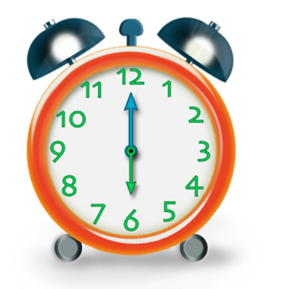
This is a game for two players. You can use the digital interactive tool accessible here, or you could print off a page of blank clock faces.

Set the time on the clock to 6 o'clock to start the game.

Decide who will go first (player 1) and who will go second (player 2).

Take it in turns to choose to move the hands of the clock on by hour or by 1 hour. For example, player 1 could choose hour, so the clock hands move to 6.30, then player 2 might choose 1 hour, moving the clock hands to 7.30... etc.

The winner is the player who moves the hands exactly onto 12 o'clock.

Can you work out a winning strategy so that you can always beat your opponent?

Clock

Source: Stop the Clock 


Math Talk: How many will fit?

Explore the following image. What do you notice? What do you wonder? 

Rectangles and Square

  • How many squares do we need to completely cover the rectangle?
  • How do you know?
  • How could you check? 

Source: Spatial Sense Learning Activity


Math talk answer:

4 squares are needed to cover the rectangle.

We could guess how many are needed.

Or we could measure by using cut-outs of the small square. 

4 squares in rectangle


Math Strategies: Early Subtraction

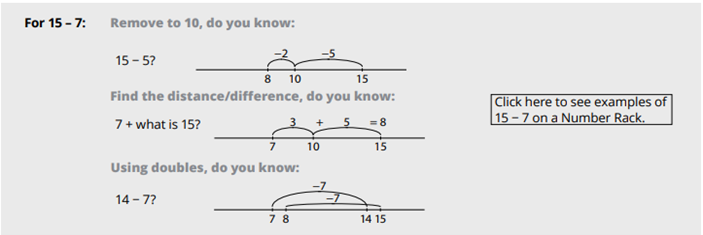
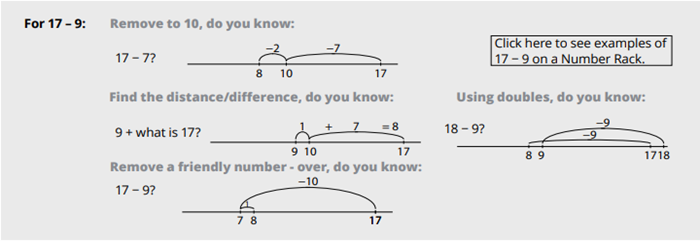
This is the third strategy in our series of featured math strategies. This month, we’re focusing on Remove to 10 or Down Over 10. The “Remove to 10” strategy (Pam Harris), also called “Down Over 10” (Dr. Alex Lawson) supports students in developing flexible understanding of subtraction by leveraging friendly benchmark numbers. By first removing an amount to reach the nearest ten, students break a problem into simpler, more manageable steps that highlight place‑value relationships. This helps them see subtraction not as a rote procedure, but as a process of decomposing numbers strategically. Over time, students build stronger number sense, increased efficiency, and a deeper grasp of how subtraction works within our base‑ten system.

Early subtraction Early Subtraction 2

Image Source: Math is FigureOutAble! The Most Important Numeracy Strategies, Pam Harris.

Try these questions at home using the “Remove to 10” strategy:

14 – 6 =

16 – 8 =

13 – 6 =

15 – 9 =

17 – 9 = 


Thinking Task

  1. How many objects can you find that are longer than three handspans but shorter than four handspans?
  2. What is longer than two of your foot lengths but shorter than three of your foot lengths?
  3. Can you find something that is the same length as your height?

Source: Good Questions for Math Teaching Why Ask Them and What to Ask Grades K-6. Sullivan, P and Lilburn Pat. P. 67. 


Real-World Math Connection

Incorporating cooking and baking into everyday family life gives children a natural, meaningful way to practice measurement skills. As they scoop flour, pour liquids, compare container sizes, or set timers, they’re engaging with real examples of volume, mass, temperature, and time. Recipes become hands-on math problems where kids learn to read units, estimate quantities, and adjust measurements when doubling or halving ingredients. Because these tasks feel purposeful—not like a worksheet—children build confidence and number sense while contributing to something the whole family can enjoy.

The Original Rice Krispies® Squares Recipe

Ingredients

  • 50 ml or 1/4 cup margarine or butter
  • 1.25 L or 5 cups miniature or 40 regular (250 g pkg) marshmallows
  • 2 ml or 1/2 tsp vanilla extract (optional)
  • 1.5 L or 6 cups Rice Krispies® cereal

Directions

  1. In large saucepan melt butter over low heat. Add marshmallows and stir until completely melted. Remove from heat.
  2. Stir in vanilla. Add Kellogg's® Rice Krispies® cereal. Stir until well coated.
  3. Using buttered spatula, press into a 3 1/2 L OR 13" x 9" buttered pan.
  4. Cool. Cut into bars.

Note for parents:

In keeping with good allergy practices, we remind you to be aware of allergens and to check labels on any packaged goods used. This recipe has been tested using Kellogg's® cereal products. Results with other products may vary.

Source: The Original Rice Krispies® Squares Recipe


Looking for additional math resources?

Check out our past e-newsletters for more fun and exciting math games and challenges to do at home.

Family Math E-Newsletter 2025-26