Junior Family Math Newsletter - February 2026

Have you been loving our Math Family Newsletters?

We’d love to hear how they’ve been helping your family explore math in fun and meaningful ways!

Take our quick survey and share how you’ve been using the newsletter — and you’ll be entered for a chance to win an exciting Family Math Prize!

Take the survey now and join the fun!
Children doing math on a whiteboard

Activities for February

Math Talk

Puzzles are more than just fun—they’re powerful tools for building spatial reasoning, a key foundation for strong measurement skills. When children rotate pieces, look for patterns, and figure out how shapes fit together, they’re practicing the same mental skills they’ll later use to compare lengths, estimate distances, and understand area and volume. Jigsaw puzzles, tangrams, and even block-building challenges help kids visualize objects from different angles and make sense of how parts relate to a whole. By including puzzles in your family’s routine, you’re supporting the kind of flexible thinking that helps children confidently tackle measurement tasks at school and in everyday life.

Challenge: Use a single, straight-line to cut this shape into two pieces that can be arranged into a square.
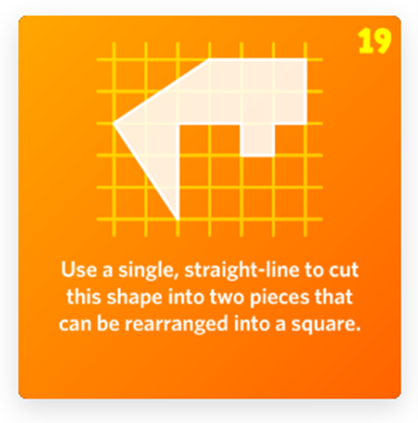
Math Challenge

Source: Visit Puzzle Calendars – Mathigon for additional puzzles and challenges.

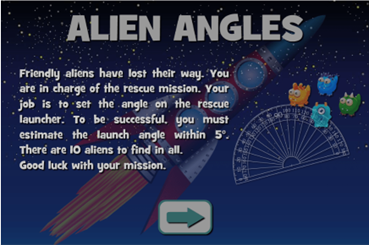
Digital Math Game: Alien Angles

Math games that focus on estimating angles help children build strong intuition for geometry in a playful, low‑pressure way. As kids compare angles, make quick guesses, and check their accuracy, they develop a sense of spatial awareness and learn to visualize turns and rotations. These skills support later success with measurement, geometry, and real‑world tasks—like reading clocks, navigating maps, or understanding direction. Fun, hands‑on games make angle sense feel natural, helping children grow confident in their mathematical thinking.

Challenge: Can you estimate the size of a given angle? Can you find all 10 aliens by estimating within 5o of a given angle?

Alien Angels


Source: Math Playground


Thinking Task: Colourful Tower

Math Strategies

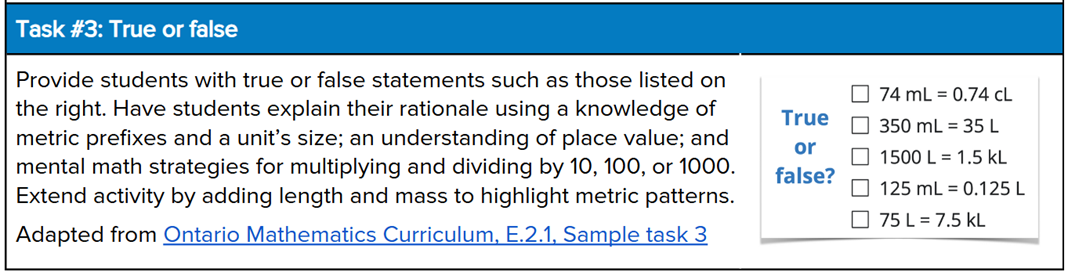
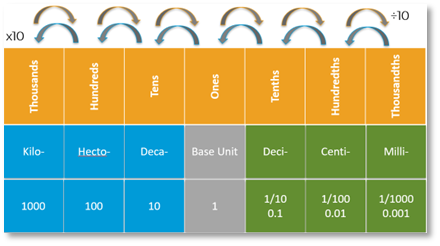
Our measurement system is built on “powers of ten.” This means that when we understand place value—how digits shift when we multiply or divide by 10, 100, or 1 000—they can make sense of why the numbers shift digits on the place-value chart when calculating conversions. Without this foundational understanding, measurement can feel like memorizing rules instead of understanding how numbers and measurement conversion work.

Math Strategies


Real-World Math Connections

Finding the math in our everyday lives sparks curiosity and builds on what we’re interested in. Making these real‑world connections, we develop a deeper understanding of math and learn to use it confidently and flexibly in meaningful ways. 

Olympic Speed Skating

For example, use Olympic events as natural examples of metric measurement.

  • Speed skating times → Convert seconds to minutes
  • Ski jump distances → Compare metres vs. kilometres
  • Bobsled speeds → Convert km/h to m/s

Prompt example:
“How many metres is that jump? How many more metres to make one kilometre?”


Looking for additional math resources?

Check out our past e-newsletters for more fun and exciting math games and challenges to do at home.

Family Math E-Newsletter 2025-26