Intermediate Family Math Newsletter - February 2026

Have you been loving our Math Family Newsletters?

We’d love to hear how they’ve been helping your family explore math in fun and meaningful ways!

Take our quick survey and share how you’ve been using the newsletter — and you’ll be entered for a chance to win an exciting Family Math Prize!

Take the survey now and join the fun!


Activities for February

Problem Solving


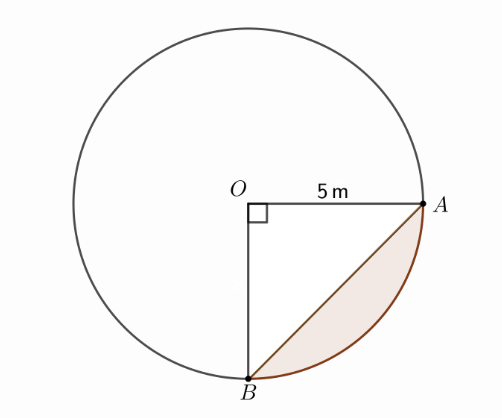
A sprinkler sprays water in a circular region with a radius of 5 m. It is positioned in such a way that some of the water is landing on a nearby sidewalk.

In the diagram, the circle with centre O represents the circular region covered by the water sprinkler. Points A and B lie on the circle with ∠AOB = 90° and OA = 5 m. The shaded region, which is the region inside sector AOB but outside of △AOB, represents the region of the sidewalk where water is landing.

Triangle AOB, where OA equals 5m


Determine the area of the region of the sidewalk where the water is landing, correct to one decimal place.

Source: CEMC Problem of the Week

Check out the above resource for answers and other problems from The Center for Education in Mathematics and Computing



Math Talk

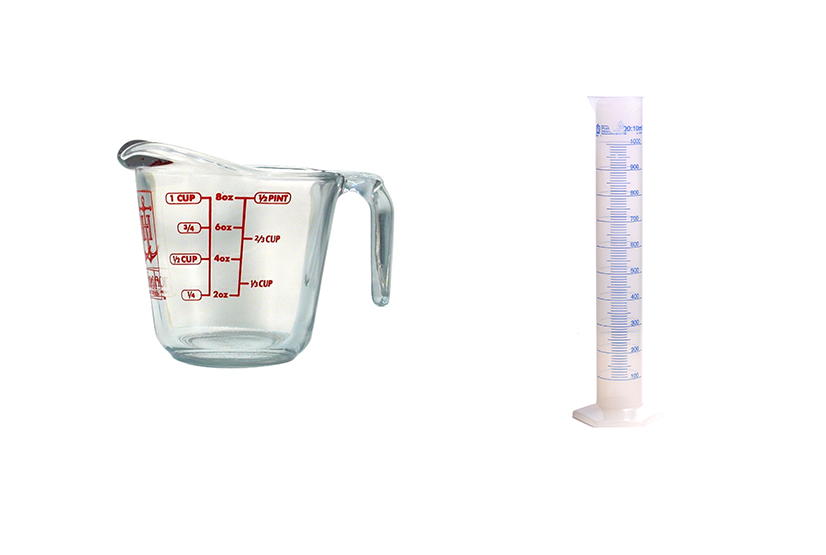
How are these the same? How are they different?

Measuring cup compared to a tube

Source: Same But Different Math


Math in the Workplace: Pharmacists


Pharmacist

“The main role of pharmacists is to fill prescriptions based on the instructions given by physicians/ doctors on the proper amounts of medication to give to patients. They are also expected to check if the patient is taking any other medications or if the patient has any medical conditions that will interfere with the prescribed medication. They are expected to give the patient the details of the medication such as: dosage amounts, potential side effects, advice on diet exercise, and other medical advice.” Source: My BluePrint

Where Is the Math?

  • Use precise measurements to prepare medications safely.
  • Measure liquids in milliliters (mL) and weigh ingredients for accurate doses.
  • Calculate dosages based on age, weight, and medical needs.
  • Convert between units (ml, mg, g) and adjust amounts for different patients.
  • Use ratios, fractions, and proportional reasoning when mixing or diluting medicines.
  • Double‑check measurements to prevent errors and keep patients safe.

Source: Co-pilot


Parent Resource

When students know and use math vocabulary, it supports their understanding, confidence, and achievement in math.

Did you know the Elementary Mathematics and MTH1W Grade 9 Mathematics curriculum document contain a glossary of terms? There are different ways you can support your child at home in enhancing their understanding of mathematics vocabulary.

Try this:
Choose one or two math words from the glossary your child is currently learning (for example: percent, ratio, mean, composite shape). Ask your child to:

  • Explain the word in their own words
  • Find something at home that shows the math word (store flyer with discounts, sports statistics, including wins/loses, ingredients in a recipe, daily temperatures for the week, what 2D shapes are within a large shape/image etc.)
  • Use the word in a sentence (“The ratio of wins to loses is…”)

Deliberate Practice


Try out some Area Mazes to refine your skills in calculating area of various rectangles and composite shapes.

Area Maze


Source: Transum Math


Mini Metric Olympics

Get in the spirit of the Olympic Games by having a Family Mini Metric Olympics.  For each even list below, estimate your score, then measure your actual score. 

Olympic Rings

Source: Math Equals Love


Straw Javelin Throw
  1. Place your feet on the starting line. 
  2. Throw the "javelin". You may only have one throw.
  3. Estimate the distance (in cm) that you threw the "javelin."
  4. Record this estimate.
  5. Measure the distance from the starting line to the position of the "javelin."
  6. Record the actual distance.

Activity Adapted from Math + Science: A Solution by AIMS Education Foundation

Paper Plate Discus
  1. Place your feet on the starting line. 
  2. Throw the "discus". You may only have one throw.
  3. Estimate the distance (in cm) that you threw the "discus."
  4. Record this estimate.
  5. Measure the distance from the starting line to the position of the "discus."
  6. Record the actual distance.

Activity Adapted from Math + Science: A Solution by AIMS Education Foundation

Cotton Ball Shot Put
  1. Place your feet on the starting line. 
  2. Throw the "cotton ball shot". You may only have one throw.
  3. Estimate the distance (in cm) that you threw the "shot."
  4. Record this estimate.
  5. Measure the distance from the starting line to the position of the "cotton ball."
  6. Record the actual distance.

Activity Adapted from Math + Science: A Solution by AIMS Education Foundation

Right-Handed Marble Grab
  1. With your right hand only, grab a fistful of marbles from the container.
  2. Place the marbles on the balance scale.
  3. Estimate (in grams) the mass of marbles you grabbed in your right hand.
  4. Record this estimate.
  5. Measure the mass of the marbles.
  6. Record the actual value.

Activity Adapted from Math + Science: A Solution by AIMS Education Foundation

Left-Handed Sponge Squeeze
  1. Observe the sponge soaking in water.
  2. Squeeze sponge into a separate container. You may only squeeze the sponge one time.
  3. Estimate the amount of water (in ml) you squeezed out of the sponge.
  4. Record this estimate.
  5. Measure the water squeezed.
  6. Record the actual value.

Activity Adapted from Math + Science: A Solution by AIMS Education Foundation

Looking for additional math resources?

Check out our past newsletters for more fun and exciting math games and challenges to do at home.

Family Math Newsletters 2025-26