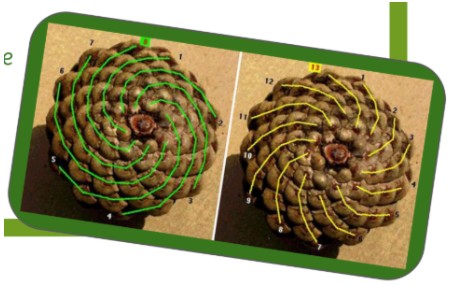
Go for a walk, bike ride, or play outside, and look for pinecones. If it is permitted to collect them, bring home one or two pinecones to investigate. Otherwise, you can explore them where you find them.
Look closely at the scales on the pinecone. Can you see spirals that curve in two different directions?
- Choose one direction and count the spirals.
- Count the spirals that curve in the other direction.
- Compare your two counts.
Many pinecones have spiral counts that are neighbouring numbers in the Fibonacci sequence: 1, 1, 2, 3, 5, 8, 13, …
In this pattern, each new number is found by adding the two numbers before it:
2 + 3 = 5 and 3 + 5 = 8.
Try asking:
- What do you notice about the spirals?
- How did you decide where one spiral begins and ends?
- What are your two counts? How are they related?
- Can you find a Fibonacci number in each count?
- Do all pinecones have the same number of spirals? What might explain any differences?
Some natural objects may show spiral counts, petal numbers, or leaf arrangements that connect to Fibonacci numbers.
Look closely at sunflowers, flowers, pineapples, and some plant leaves.
Can you find another object in your natural environment that has a repeating pattern, spiral, or arrangement worth investigating?
Adapted from: The Robertson Program